EICR for buying and selling a home
An EICR before you sell, or before you commit to buy. Not a legal requirement for a sale in England, but the seller’s property information form asks about electrical work and certificates, and a buyer who plans to let will want a current report.
Registered with NICEIC under the Domestic Installer Scheme since September 2020 Check it on the NICEIC register
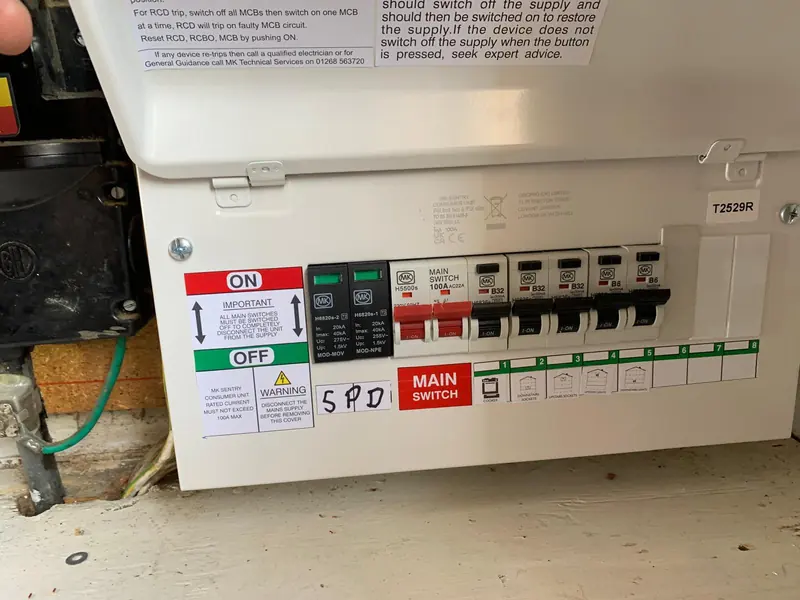
A finished replacement board, main switch and surge protection labelled.
The honest answer
There is no legal requirement for an EICR when you sell a home. But the seller’s property information form (TA6) asks about electrical work and certificates, and buyers who plan to let will want a current EICR. Electrical Safety First recommends an inspection before selling or buying a previously lived-in home.
Source: Law Society, TA6 6th edition; Electrical Safety First, periodic inspection
Selling
A report in hand answers the electrical questions before the buyer’s solicitor asks them, and any defect is yours to price and fix on your own timetable rather than a surprise in the middle of the chain.
Buying
A report before exchange tells you what you are taking on: the state of the board, the earthing and the wiring, in writing, with codes.
The TA6 questions
Section 11 of the TA6 (6th edition, which replaced the earlier editions on 30 March 2026) covers electrical works. Here is what it asks and which paper answers it.
| The question | What answers it |
|---|---|
| Has electrical work been done at the property? | A building control completion certificate, the installer’s Building Regulations Compliance Certificate, or the BS 7671 Electrical Installation Certificate, attached to the form. |
| A new consumer unit or fuse box | The work the TA6 lists includes replacing a consumer unit. As a NICEIC Domestic Installer, J D Kent Electrical can notify Building Control of it, and the compliance certificate follows. |
| An EV charging point | The list also includes installing EV charging points; a charger on its own new circuit is notifiable work. |
| Is there an EICR? | A current EICR, with its date and its result. |
Source: Law Society, TA6 6th edition
Buy-to-let and older houses
Two kinds of buyer ask for an EICR even though the law does not. The first is anyone buying to let. From the day the first tenancy starts the property needs a satisfactory report, so an investor who finds out after completion that the board has no RCD protection is paying for remedial work before the first rent comes in, on a timetable set by the letting date rather than their own. The second is the buyer of an older house, where the survey mentions an old fuse box, a board with a wooden back, or wiring that looks tired. A surveyor looks and notes; an electrician tests. The report turns "the electrics may need attention" into a list, circuit by circuit, with each defect coded, and a list can be priced. For a seller the same logic runs the other way: a defect found by the buyer’s electrician in week six of a sale becomes a negotiation, while the same defect found and fixed by you in week one is a line on a certificate.
Buying and selling questions
Do I need an EICR to sell my house?
No. There is no legal requirement for an EICR when you sell a home in England and Wales. The Law Society says so in its notes to the TA6.
What will my solicitor ask for?
The TA6 asks whether electrical work has been done and for its certificate: a building control completion certificate, the installer’s Building Regulations Compliance Certificate or the BS 7671 Electrical Installation Certificate. It also asks about the EICR.
Should a buyer get one?
Electrical Safety First recommends an inspection before buying a previously lived-in home. A buyer who plans to let the property will need a current report anyway.